
What Is the Difference Between Inside Recess and Outside Recess Blinds?
It comes down to position. Where does the blind sit relative to the opening?
Inside recess: the blind sits inside the opening.
Outside recess: it sits in front, usually fixed to the wall around it.
That one difference in position ripples out into appearance, light gaps, whether the window still opens, and how you measure the thing.
What Are Inside Recess Blinds?
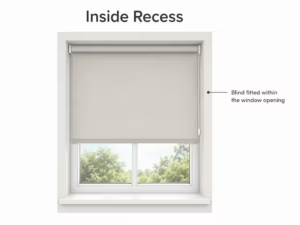
Inside recess blinds sit within the window opening, brackets fixed either to the top of the recess or to the sides, depending on the system. Most of the blind stays contained within the depth of the wall.
Some people call this a recess fit.
It reads as neat and integrated because the blind respects the existing proportions of the window instead of fighting them. Picture a roller blind mounted between the two side walls of a bedroom window, brackets and tube and fabric all tucked inside the opening. That’s an inside recess fit.
What Are Outside Recess Blinds?
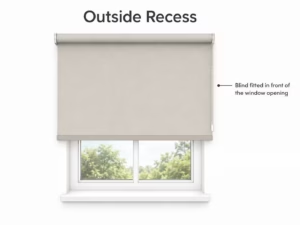
Outside recess blinds sit in front of the opening rather than within it. Brackets usually go on the wall above the recess, though the exact position depends on the blind and what surface is actually available to fix into.
The blind itself is usually wider than the opening, and often taller too. That’s what creates the overlap around the window. Some retailers call this an exact fit, though the terminology shifts from supplier to supplier.
Picture a Roman blind mounted above a living room window, extending past both sides of the opening. That’s an outside recess fit.
Inside Recess vs Outside Recess at a Glance
| Attribute | Inside Recess | Outside Recess |
|---|---|---|
| Fitting position | Within the window opening | In front of the window opening |
| Appearance | Neat and integrated | More prominent |
| Wall overlap | None or minimal | Yes |
| Light gaps | Usually more visible | Can be reduced with overlap |
| Recess depth needed | Yes | No |
| Obstruction risk | Higher | Lower |
| Window area when blind is raised | Can be partly occupied | Often more exposed |
| Measuring method | Measure inside the opening | Measure the required coverage area |
| Best suited to | Clear, sufficiently deep recesses | Shallow or obstructed recesses |
Should Blinds Go Inside or Outside the Window Recess?
Go inside when the recess is deep and clear, and you want that neat look. Go outside when the recess is shallow, something’s in the way, you need more coverage, or light gaps around the edge bother you more than a perfectly integrated appearance.
That’s the short version. The useful version needs you to actually look at the window.
Choose Inside the Recess When…
- The recess has enough usable depth.
- Handles and vents won’t get in the blind’s way.
- The window can still open without hitting the blind.
- You want a neat, minimal look.
- You’d rather the wall stayed visible.
- Curtains or another treatment will sit in front anyway.
An inside fit works best on a straight, clear, sufficiently deep opening. In a modern bedroom, a simple recess-fitted roller blind can practically vanish into the architecture.
Clean. Contained. Quiet.
Choose Outside the Recess When…
- The recess is too shallow.
- Handles project straight into the blind’s path.
- The window opens inwards.
- You want more overlap around the opening.
- The recess itself is uneven and the blind needs to clear it.
- You want the window to look bigger than it is.
Shallow or obstructed recesses often push people toward a face-fixed installation, and that extra room in front of the window means the blind can operate without snagging on frames, vents, or fittings.
What Are the 7 Main Differences Between Inside and Outside Recess Blinds?
Fitting position changes more than how the blind looks. It changes how the blind relates to the window, the wall, and the room itself.
1. Fitting Position
The defining difference is spatial. Inside, the blind sits between the sides of the opening, still visually connected to the frame. Outside, the blind sits in front, overlapping the wall and covering more ground.
Think of it as layers stacked in a different order:
Inside recess: room, wall, recess, blind, window frame.
Outside recess: room, blind, wall and recess, window frame.
That single positional swap influences almost every comparison in this guide.
2. Appearance
Inside recess blinds generally read cleaner. Because the blind stays within the opening, it feels less dominant in the room, and more of the surrounding wall stays visible. That suits modern interiors with simple lines, which is exactly why recess fittings get chosen so often. They stay out of the way.
Outside recess blinds do the opposite. The blind becomes part of the wall rather than something tucked inside it. A wider fitting can make a small window look more substantial, and mounting above the recess adds a sense of height.
This is where decorative Roman blinds earn their keep. A good pattern or a rich fabric deserves to be seen, not hidden inside a recess.
3. Light Control
Inside recess blinds normally need clearance around the sides to operate, and that clearance varies by blind system, mechanism, and the shape of the opening itself. Some systems leave more visible edge gaps than others.
Outside fitting overlaps the top and sides of the opening, which can cut down on light entering around the perimeter. That doesn’t mean an outside fit guarantees total darkness. It doesn’t. And fitting a blackout fabric inside the recess doesn’t automatically make the room fully dark either.
Light control depends on the whole picture: blind type, fabric, side gaps, top gaps, bottom gaps, wall shape, fitting position, overlap. For bedrooms, nurseries, and rooms that get hit by bright summer evenings, these details actually matter.
4. Required Recess Depth
Inside fitting needs enough usable recess depth. Usable is the operative word.
A recess can look deep at first glance and still have part of that space eaten up by window handles, trickle vents, tiles, decorative mouldings, projecting frames, or an inward-opening window.
Required depth changes with the blind too. A roller tube barely needs anything. A vertical blind headrail needs more. Timber Venetian blinds stack up deeper still, and motorised systems often need the most room of all, thanks to larger headrails, motors, and the extra hardware that comes with them.
There’s no single minimum depth that works across every blind. The right measurement is whatever clear space the actual system you’re fitting needs.
5. Window Access and Opening
A blind shouldn’t turn your window into a hassle to use.
Inside fitting can clash with inward-opening windows, tilt and turn mechanisms, protruding handles, ventilation, and cleaning access. A blind can technically fit inside the recess and still be the wrong choice in practice.
Take a Venetian blind that clears the frame fine when raised, then clashes with the window handle the second it’s lowered. Or a Roman blind that fits the opening but stops the window opening freely once the fabric stack builds up.
Check the blind through its full range of movement, and the window through its full range too. Not just how everything looks when it’s all closed up.
6. Space Around the Window
Outside fitting needs clear wall space, which sounds obvious until you actually try to find it.
A nearby cupboard can eat into the available width. A radiator can affect the drop you’d planned. Curtain tracks, poles, and brackets often want the exact same real estate above the window.
Furniture matters here too. A blind that projects further into the room can catch on shelving, a wardrobe door, or a deep window display.
Inside fitting keeps more of the wall free, which is why it tends to win in tighter rooms.
7. Measuring Method
The measuring principle flips with the fitting position. Inside, you measure the opening. Outside, you measure the total area you want the blind to cover.
Inside recess measurements get taken in several places, because window openings are rarely as square as they look. Width gets measured at the top and bottom, with a check in the middle too. Drop gets measured at the left, the centre, and the right.
For most blind types, the smallest measurement wins for a recess fit, though product-specific instructions can override that. Always follow the measuring method that comes with your chosen blind.
What Are the Advantages of Fitting Blinds Inside the Recess?
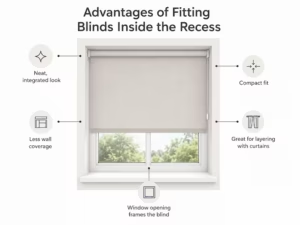
Inside recess blinds are popular for a simple reason: when the opening cooperates, the result feels effortless.
5 Benefits of Inside Recess Blinds
Neat Appearance
The blind stays visually contained inside the opening, and the recess acts almost like a frame around it.
Less Wall Coverage
More of the wall stays visible, which matters if you’ve got paintwork, wallpaper, or architectural details worth keeping in view.
Compact Fitting Position
The blind projects less into the room. That helps in smaller bedrooms, narrow hallways, or compact flats where every inch counts.
Plays Well With Curtains
Recess-fitted blinds often sit neatly behind curtains, handling privacy and light near the glass while the curtains bring softness and insulation in front. It’s a combination that works particularly well in British bedrooms and living rooms.
Clearer Window Proportions
The recess edges frame the blind naturally, so the finished install feels ordered rather than bolted on.
When Is an Inside Recess Fit Most Effective?
Usually when the window has a deep recess, reasonably straight sides, minimal obstructions, a standard opening arrangement, and a decent fixing surface. More clear space, easier the fit.
What Are the Disadvantages of Fitting Blinds Inside the Recess?
None of this is a defect in the blind. It’s a trade-off, and it’s worth knowing about before you measure up rather than after.
5 Potential Drawbacks of Inside Recess Blinds
Edge Light Gaps
Clearance around the blind lets light in at the sides. How much depends on the system and the shape of the recess.
Reduced Usable Recess Space
The blind eats into part of the opening. That can matter on a narrow sill or a window ledge you actually use for plants or ornaments.
Handles Get in the Way
This is probably the single most common reason a recess that looked fine on paper turns out not to be.
Part of the Glass Stays Covered
Even raised, some blinds leave a headrail, roller, or fabric stack sitting in the opening, cutting into the visible glass.
Uneven Recesses Complicate Things
Older British homes have character. What they don’t reliably have is a perfectly square window opening, and uneven plaster or sloping walls can make a recess fit genuinely tricky.
Can an Inside Recess Blind Make a Window Look Smaller?
Yes, it can. The blind sits within the existing dimensions, so the eye reads the blind and the opening as one shape. The headrail, roller, or raised fabric stack eats into the visible glass area too.
How much depends on the blind. A slimline roller barely registers. A thick timber Venetian creates a proper stack once raised, and that’s a lot more visual weight sitting at the top of your window.
What Are the Advantages of Fitting Blinds Outside the Recess?
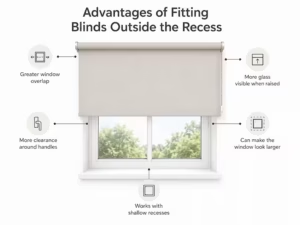
Outside fitting simply gives the blind more room to work with, which makes awkward windows easier to cover and gives you more say over how much overlap you want.
5 Benefits of Outside Recess Blinds
More Overlap
The blind extends beyond the sides and top of the opening, improving overall coverage.
More Flexibility Around Obstructions
Sitting further forward, the blind can clear handles and vents that would otherwise get in the way.
Works for Shallow Recesses
The blind doesn’t need to sit inside the available depth at all. That solves the problem outright when there simply isn’t enough space.
More Glass Exposed When Raised
Depending on the blind and fitting height, the headrail or stack can sit above more of the window, letting in more daylight once the blind’s open.
Makes the Window Look Bigger
Extend the blind beyond the opening and the window appears wider. Mount it higher and you add a sense of height too.
Do Outside Recess Blinds Block More Light?
They can reduce perimeter gaps, because the blind overlaps the sides and top of the opening. The actual result still depends on the blind type, the fabric, the installation position, the overlap, and the shape of the wall.
More coverage helps. It’s not the same thing as complete blackout, and nobody should promise you that it is.
What Are the Disadvantages of Fitting Blinds Outside the Recess?
Outside fitting buys you flexibility, and it asks more of the space around the window in return.
5 Potential Drawbacks of Outside Recess Blinds
You Need Suitable Wall Space
The blind has to be fixed somewhere secure, and not every wall offers that.
More of the Wall Gets Covered
Not great news if you’re trying to preserve paintwork or architectural detail.
The Blind Projects Further Into the Room
Headrail and fabric sit forward of the wall, which matters more in a compact space.
It Can Clash With Furniture or Curtain Fittings
Poles, tracks, shelves, and tall furniture all need factoring in.
Overlap Needs Planning
Too little and you don’t get the coverage you wanted. Too much and you’re fighting nearby fittings instead.
Can Outside Recess Blinds Interfere With Curtains?
Yes, especially when both treatments are competing for the same wall space. The relationships that matter: blind projection, curtain pole position, curtain track position, the fabric stack, and the window handles.
A Roman blind fitted outside the recess can end up fighting a curtain pole mounted right above it. The fix is simple enough. Plan the blind and the curtains together, as one window treatment, rather than deciding their positions in isolation. It leads to a cleaner result almost every time.
Which Blind Types Work Best Inside or Outside the Recess?
Most common blind types can go either way. The right choice comes down to the size of the mechanism, how the blind moves, and the shape of the window.
Roller Blinds
Compact by design, roller blinds suit recess fitting well. Inside, they look simple and minimal. Outside, they can offer more side overlap where cutting down edge light matters.
Worth remembering: the fabric itself is sometimes narrower than the mechanism. Always follow the product-specific measuring instructions rather than assuming.
Roman Blinds
These work in either position. Inside, the fabric sits neatly contained within the opening. Outside, you get more flexibility, and the raised fabric stack can sit above more of the window, exposing more glass.
Decorative fabrics tend to make more of a statement mounted beyond the recess edges, and motorised Roman systems usually need extra depth for the headrail and motor.
Vertical Blinds
These need room for both the headrail and the rotating vanes, and handles can interfere with the slats as they turn. Outside fitting often gives more clearance around a difficult window.
On larger windows and doors, stacking direction matters too: one side, split down the middle, or gathered elsewhere entirely, depending on the opening and the room layout.
Venetian Blinds
Recess depth affects how freely the slats can tilt and rise, and handles can restrict movement further. Outside fitting tends to offer more clearance.
Timber and faux wood blinds create a deeper stack than slimmer systems, which becomes more noticeable on taller windows.
Pleated and Cellular Blinds
These generally suit recess fitting well, thanks to their neat, contained look against modern frames. Still worth checking handles and recess depth before assuming. Specialist frame-mounted systems are a different case, since they attach directly to the glazing or frame rather than the recess.
Electric and Motorised Blinds
These need a bit more planning up front. Check motor dimensions, headrail depth, power access, battery access, charging access, and window clearance.
A recess that comfortably fits a manual blind might not have room for the motorised version of that same product.
Is Inside or Outside the Recess Better for Blackout Blinds?
Neither position guarantees blackout on its own. What changes is how much light can still reach the room around the edges.
Why Do Inside Recess Blinds Have Light Gaps?
A few reasons: operational clearance, fabric that’s narrower than the mechanism, uneven recess walls, and gaps at the sides and top. The blind needs room to move safely, and that room is exactly where light gets in.
Can an Outside Recess Fit Improve Room Darkening?
It can. Extra overlap at the sides, the top, and sometimes the bottom adds up to greater overall coverage, which reduces light around the perimeter.
But a blackout fabric only describes the opacity of the material itself. It doesn’t eliminate light sneaking in around the edges of the blind. That distinction matters more than people expect.
Which Fit Is Better for Bedroom Blinds?
Depends what you’re optimising for.
Want appearance? Go inside recess.
Want less edge light? Go outside recess, with proper overlap.
Want serious light control? Look at a specialist cassette or side-channel system built to manage the light around the blind itself.
There’s no single right answer for bedrooms. It comes down to how dark you actually want the room and how much a minimal look matters to you.
How Do Window Handles and Opening Windows Affect the Choice?
A blind and a window have to share the same space, and that’s exactly where most fitting problems start.
Check the Blind’s Full Path of Movement
Think about what the blind actually does across a normal day: raise, lower, tilt, rotate, fold, stack. A handle that’s no problem when the blind’s raised can suddenly catch it once lowered. A vertical blind might clear the window fine when open, then hit the handle the moment the vanes rotate.
Test the whole path, not just one position.
Check How the Window Opens
Outward-opening, inward-opening, tilt and turn, French doors. Each needs its own space.
Outward-opening windows tend to play nicer with recess-fitted blinds, since the moving part travels away from the room. Inward-opening windows need more care, full stop.
Check Fixed Obstructions
Handles, trickle vents, locks, tiles, sills, radiators. Small details, and they can quietly decide the whole fitting position for you.
Expert fitter note: measure the usable space, not the visible depth of the recess. A recess can look plenty deep right up until the blind’s lowered and catches a handle, a vent, or the window itself mid-opening.
How Do You Know Whether a Window Recess Is Deep Enough?
Measure the clear, usable space, not the deepest part of the recess. The shallowest useful part is the one that counts.
Measure the Shallowest Usable Depth
Start at the front edge of the recess and measure back toward the window, stopping at the first obstruction that would actually affect the blind. Check across the full width, not just one spot, then compare that figure against what the chosen blind system needs.
Why Does Required Depth Vary by Blind Type?
Because every blind occupies the recess differently. A roller tube, a Roman blind headrail, Venetian slats, a vertical blind headrail, a motor housing, a cassette system: each has its own profile. That’s exactly why there’s no single depth figure that works for everything.
What Happens if the Recess Is Too Shallow?
The blind can protrude past the front of the recess, catch on a handle, restrict the window, or just look wrong. Fitting outside the recess is usually the practical fix.
How Do You Measure for Inside Recess Blinds?
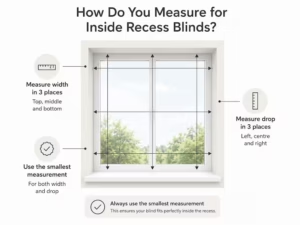
This is about understanding the true shape of the opening, and one measurement almost never tells you that.
Measure the Width in Multiple Places
Top, middle, bottom. Don’t assume the sides run parallel, because plenty don’t.
Measure the Drop in Multiple Places
Left, centre, right. Small differences here are the norm, not the exception.
Why Are Multiple Measurements Needed?
Walls move. At least visually. Plaster settles unevenly, recesses taper, older homes shift over decades, and even modern builds aren’t always perfectly square. Most standard methods take three width measurements and three drop measurements for exactly this reason.
The exact figure to use depends on the blind and its fitting instructions. For the full step-by-step process, see our How to Measure for Blinds guide.
How Do You Measure for Outside Recess Blinds?
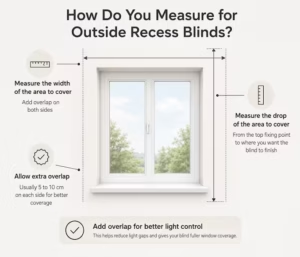
This is about coverage, not the internal size of the opening. You’re measuring the area you want the blind to cover, not the hole in the wall.
Measure the Window Recess
Start with the basic width and height of the opening as your reference point.
Decide How Far the Blind Should Overlap
Think about coverage at the left, right, top, and bottom. The right amount depends on the blind system, the room, and what you’re actually trying to achieve. Don’t assume one overlap figure suits every product.
Check the Surrounding Wall
Look past the window itself: light switches, sockets, shelving, cupboards, curtain poles, radiators. A wider blind might solve one problem and create another somewhere else on the wall.
Check Where the Brackets Can Be Fixed
Blind width and bracket position both need a suitable fixing surface. A blind can be exactly the right size for the window and still be unworkable if the brackets have nowhere secure to go.
Inside Recess vs Outside Recess Blinds: Which Looks Better?
Neither wins outright. They just create different effects.
Inside Recess for a Minimal Look
Suits clean lines, modern interiors, visible architraves, and curtains hung in front. The blind feels tied to the window rather than the wall, which reads quieter.
Outside Recess for a More Decorative Look
Works especially well with patterned Roman blinds, bolder proportions, statement fabrics, and recesses you’d rather disguise than show off. A well-chosen blind here becomes part of the room’s design, not just a functional cover.
Which Fit Makes a Small Window Look Bigger?
An outside-mounted blind, easily. Extend it past both sides and the window reads wider. Mount it higher and the room gains a sense of height too.
An inside fit keeps the window’s true proportions honest. Some rooms want that honesty. Others benefit from a little visual trickery instead.
What Are the Most Common Fitting Mistakes?
Most problems don’t come from a poorly made blind. They come from decisions made before the blind was even ordered.
Measuring the Recess Only Once
One measurement can’t tell you the opening narrows, widens, or slopes. Measure in several places, every time.
Ignoring Window Handles
A handle can quietly eat into the usable depth of a recess. Always measure to the first obstruction, not the back wall.
Forgetting How the Window Opens
This bites hardest with inward-opening and tilt and turn windows. Check the full opening path before committing.
Choosing the Fit Before Choosing the Blind
The blind changes the answer. A slim roller mechanism and a deep motorised headrail don’t need anything like the same space, so choose the product and the fitting position together.
Assuming Blackout Fabric Means No Light Gaps
Blackout describes the material. Edge light comes from the installation. Related, sure. Not the same thing.
Forgetting Curtains, Radiators, and Furniture
The window doesn’t exist on its own. A gorgeous outside-fitted blind isn’t much use if it clashes with the curtain pole or jams the wardrobe door.
Inside Recess vs Outside Recess Blinds: Which Should You Choose?
Go inside for a neat, integrated look when the opening has enough clear depth. Go outside when the recess is shallow or obstructed, or when overlap and coverage matter more to you than a perfectly flush appearance.
Before deciding, ask yourself:
- Is the recess deep enough for the blind you want?
- Are there handles, vents, or other obstructions?
- Will the window still open normally?
- Does reducing perimeter light matter more than a minimal appearance?
- Is there enough clear wall space for an outside fit?
The best result balances the blind, the window, and the room. It doesn’t force one fitting method onto every opening in the house.
Not sure which position suits your window? Our local specialists can measure up, check the recess for depth and obstructions, and recommend the right fit for whichever blind you’ve got your eye on.
Book a Free Home Appointment and we’ll measure your windows at home and talk through the options in person.